News

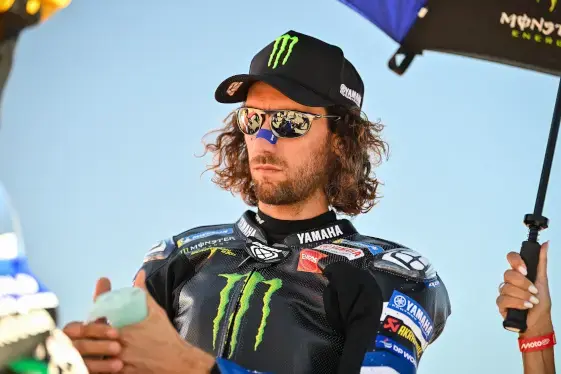
Alex Rins “I’m proud of what I’ve achieved.”

As his three MotoGP seasons with Yamaha draw to a close, Alex Rins is set to bring his racing career to an end. The Spaniard takes a mixed view of an experience that did not allow him to achieve the results he had hoped for.

You’re 30 years old. Isn’t that too young to retire?

Mentally and physically, I feel I still have strength and potential. Of that, I’m certain – 100 or even 200 per cent certain. But given the decisions that have been made, this was the only possible path for me. We have a bike that lacks performance. And with the results I’m getting on this bike, I wasn’t really in a position to secure a place with another team. When I extended my contract with Yamaha, the plan was for a medium- to long-term project. But the team has decided to take on two new riders next year...

Didn’t you consider a move to Superbike?

There were possibilities. In particular, we had two opportunities with Ducati satellite teams – let’s say half-official, half-satellite. But that option didn’t convince me enough. After fifteen years in this world championship, I’ve decided to call it a day.

Would a role as a test rider have appealed to you?

Never say never. But I’ve been with Yamaha for three years now, since 2024, and I haven’t seen a significant improvement in the bike’s performance. It’s been a real struggle. After a while, that took some of the desire to ride away from me. So, for now, I’m leaving this world – the world of MotoGP. We’ll see in six months’ time, or a year from now. The door is closed, but it isn’t locked. Right now, I need to find myself again. We live under pressure for ten or eleven months of the year. And when things don’t go the way you’d like them to, or the way you’d planned, that pressure really does end up wearing you down.

How are you approaching your final MotoGP races?

I’m feeling quite good. I’m still very ambitious and I’m trying to make the most of these final races. I’m still hungry. Our bike is fast in certain areas – in terms of top speed, through the corners, and in several sectors. But we’re also aware of its weaknesses. Despite that, I still have that desire to achieve something before it’s all over.

Are you impressed by what Fabio Quartararo is currently achieving with Yamaha?

Yes, especially in this final part of the season. During the first part of the championship, we were very close. He was getting good results, but our performances were quite similar. In the last few races, however – particularly in Austria, at Misano and in Japan – his pace was clearly superior to mine.

You’ve raced your entire MotoGP career with Japanese manufacturers. How do you explain their current struggles compared to the Europeans?

It’s hard to say. When I was at Suzuki, development was a key focus. But, for example, Yamaha also developed the bike significantly during my first two years with them, in 2024 and 2025. Every manufacturer has its own challenges and, above all, its own way of working. I don’t think it’s simply a matter of Japanese manufacturers. I wouldn’t even call it a ‘problem’. I’d rather call it a way of working.

You were runner-up in Moto3, runner-up in Moto2 and third in MotoGP. What did you lack to become world champion?

In Moto3, a corner. In Moto2, a broken collarbone. And in MotoGP, one too many injuries at Jerez. But I’m proud of what I’ve achieved. I managed to compete for the world championship in all three categories. In Moto3, from my second season onwards, I was battling it out in almost every race with Maverick Viñales and Luis Salom. In Moto2, in my very first season, I finished runner-up in the championship. And in MotoGP, in 2020, when I finished third, I dislocated my shoulder at Jerez during qualifying. I missed the first race and, in the next one, I obviously wasn’t 100 per cent. Those are the things that made a difference.

Did your serious leg injury in 2023 mark the start of the decline in your career?

No. Not at all. That year, I’d already won by my third race with Honda. Obviously, that injury put a stop to my progress at Honda – that’s for sure. But I don’t think it marked the decline of my career. I made a full recovery. It took me nearly a year to get my leg back to normal, and I might not have walked properly until 2025, but on the bike I felt absolutely fine.

It was simply a very serious injury.

What will be your fondest memory from all these years?

The battles on the track. And the people. All the people I’ve met. In this paddock, there are good and bad people, just like everywhere else. But I’ve been lucky enough to meet a huge number of people and, on the whole, a lot of really good people throughout my career.

What is your biggest regret?

I don’t even really know how to define a regret. In life, everything moves very quickly and we have to make decisions fast. Of course, I’ve made some decisions that probably weren’t the right ones. But when I made them, at that moment, I was convinced that was the right direction to take. So I don’t know if I can really talk about regrets.

How would you like fans to remember you?

I’d like them to remember me as a good bloke, a talented rider and simply the person I am.